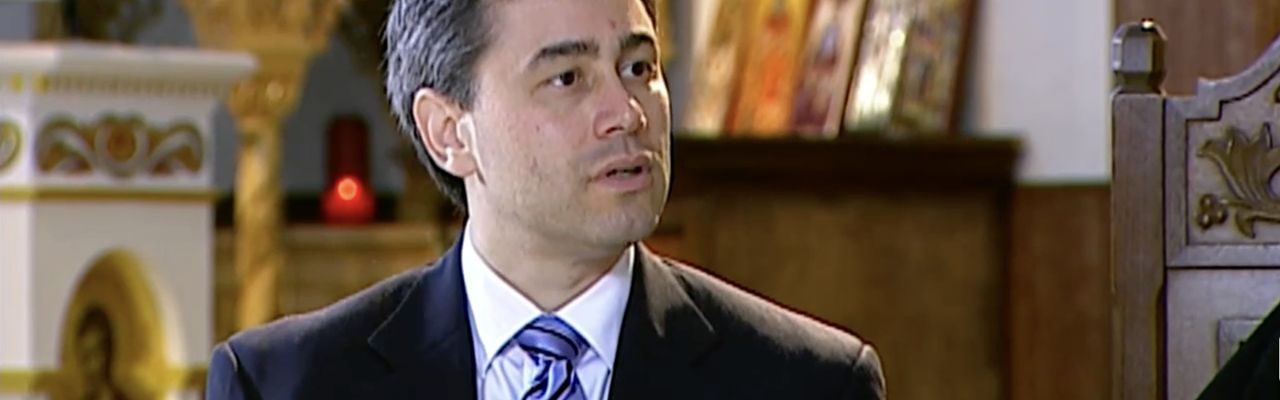

Theo Nicolakis discusses Orthodoxy in the age of New Media.
As Director of National Ministries for the Greek Orthodox Archdiocese of America, Theo Nicolakis occupies a role that sits at the intersection of parish life, national leadership, and the rapidly changing realities of the modern world. Drawing on a background in theology, technology and decades of service within the Church, Theo approaches ministry with a commitment to listening—first to clergy and parishes, and ultimately to the needs of the faithful themselves. In this conversation, he reflects on what it means to serve the Church together at every level, the challenges of stewarding limited resources, and how emerging technologies like the internet can be thoughtfully discerned and integrated through the lens of Orthodox faith.
OYM: Could you give us a brief biography—your background in the Orthodox Church and what you do now?
Theo: I’m originally from Peabody, Massachusetts, and St. Vasilios Greek Orthodox Church. I completed my undergraduate studies at Gordon College in Biblical and Theological Studies, followed by a Master of Divinity from Holy Cross Greek Orthodox School of Theology. Later, I earned a master’s degree in Management and Systems from NYU, with a focus on leadership and technology management.
I also have about ten years of experience working at the Metropolis of Boston camp and taught Sunday school for four years. Beyond that, I’ve served in a wide range of parish and metropolis leadership roles.
In 1994, I began working for the Greek Orthodox Archdiocese of America through the Youth and Young Adult Ministries Office. I was tasked with creating a centralized resource hub for youth and young adult ministries, which was originally called Orthodox Ministry Access. The vision was to help our camps and metropolis youth offices work together and share resources. That initiative evolved into the Department of Internet Ministries in 1996, where I served as the department’s first director.
In 1999, I moved from Boston to New York and went on to serve as IT Director and Chief Information Officer at the GOA. As of January 2025, I now serve as the Director of National Ministries.
OYM: What does your role as Director of National Ministries involve?
Theo: My role is to oversee and coordinate the National Ministries of the Greek Orthodox Archdiocese of America. These ministries exist to support and respond to the needs of the Church across the country.
OYM: Can you share the story behind the National Ministries and how you came into this role?
Theo: The National Ministries are intended to be responsive to the evolving needs of the Greek Orthodox Church in America. Each ministry has specific responsibilities, and their work is expressed locally through the metropolises or the parishes, where programming and ministry actually take place.
The National Ministries include the Departments of Marriage and Family, Internet Ministries, Religious Education, Stewardship, Outreach and Evangelism, Youth and Young Adult Ministries, FREEDOM Ministry (our human trafficking awareness initiative), the School of Byzantine Music, and Digital Liturgical Arts—often known as the Digital Chant Stand. In total, there are about nine national ministries.
Some of these ministries have existed for decades, dating back to the time of Archbishop Iakovos and even earlier. Collectively, their mission is to equip ministry leaders and workers for building up the Body of Christ. This mission is inspired by Ephesians 4:12, where St. Paul speaks about equipping the saints for ministry.
In my role, I bring more than thirty years of experience serving the Church at many levels—parish, metropolis, archdiocesan, national, and international. I’ve served as a parish council member and president, worked extensively at the metropolis level, and held several roles within the Archdiocese.
Beyond that, I’ve served on national boards and committees, including the American Bible Society, where I chaired the governance committee. I’ve also been involved in several international events with Ecumenical Patriarch Bartholomew, including serving as Chief Information Officer for the Holy and Great Council of Crete in 2016.
Most importantly, I am married and a father, who like many parents lives with the struggle of building an Orthodox Christian home.
All of these experiences—both personal and institutional—have given me a unique perspective on the Church, from building faith in the home to engaging at a global level. My hope is that these experiences can contribute positively to the continued growth and effectiveness of the National Ministries, not only within parishes, but within the daily lives of Orthodox Christians and their families.
I’m deeply grateful for the vision of Archbishop Elpidophoros of America along with the trust and responsibility he has placed in me; I pray that I can serve faithfully in this role.
OYM: Was there a specific moment when you realized that serving as Director of National Ministries was your calling?
Theo: I think anytime we’re involved in ministry, our posture has to be one of service and openness to God’s calling. Along the way, there have been several moments when God has either opened doors—or taken a more direct approach—especially when we act like Jonah, or Moses, or even Jeremiah, offering excuses about why we can’t or shouldn’t serve.
I’ve encountered those struggles many times throughout my ministry. But after significant prayer and reflection, this role felt like the right calling at the right time. I hope that the diverse experiences I’ve been blessed with over the past thirty-plus years can continue to inform what’s required of this role.
If there’s one guiding principle I hope to bring into this work, it’s a posture of listening. Listening in ministry is essential. What are the real needs? What are the struggles and challenges? What are the successes and opportunities happening at the parish level? Being attuned to all of that matters.
Secondly, it’s about understanding the unique opportunities that exist within a national archdiocese—the ability to convene diverse stakeholders, to bring together ministry leaders and experts who are doing meaningful work, and to amplify their impact intentionally and strategically. After listening, the goal is to construct responsive solutions that truly support parishioners and parish households, and to do so collaboratively, as a team, across the country.
I think our levels of service are layered and interconnected. We serve one another at the national level, we serve our metropolises, we serve our parishes, and ultimately we serve the household and the individual. What’s essential is that we do this work together. Ideally, each level serves in harmony with the others, with every part exercising its unique and beautiful role within the Body of Christ.
OYM: What does a typical day as Director of National Ministries look like for you?
Theo: A “typical” day is hard to define, because I try to be very intentional not only about how I structure my days, but also my weeks and months.
First and foremost, my role begins with listening—actively and intentionally listening to what is happening at the parish level across the various ministries. That means speaking with clergy as a priority, especially through the Archdiocesan Presbyters Council (APC), whose clergy representatives play a key role in helping surface what parishes are experiencing on the ground. I also make a point to reach out directly to clergy—sometimes even cold-calling—to ask about their parish life: what needs they are seeing, where they are experiencing success, what challenges they are facing, and what emerging trends they may be noticing before they ever appear at the regional or national level. They are key advisors.
A good example of this is the recent and very real blessing of an influx of converts and inquirers into the Orthodox Church. Parishes were seeing this firsthand—through seekers and catechumens—long before it appeared in national statistics through chrismations. That kind of insight only comes from listening closely at the parish level.
Second, I firmly believe that many parishes—those on the front lines of ministry—are already doing excellent work in responding creatively and faithfully to both opportunities and challenges. One of the roles of National Ministries is to identify these “centers of excellence,” recognize where things are being done particularly well, and then help lift up and share those tools, models, and practices with other communities.
At the same time, there are parishes facing unique challenges that may not have access to the specific expertise needed to address them. This creates a meaningful opportunity for the metropolis, and in some cases the Archdiocese, to step in—connecting parishes with subject-matter experts, tools, and resources that support overall parish health and vitality.
Finally, a significant part of my work—especially over this past year—has involved thinking intentionally about what a healthy future state for ministry looks like. One major step in that process was the launch of a national survey across the Archdiocese, which closed on January 15. We surveyed clergy, ministry leaders and workers, and parish council presidents to better understand the real needs, challenges, and opportunities facing our parishes today. Our goal is to align both our strategic priorities and our financial resources in direct response to what parishes are telling us—and, ultimately, to envision an ideal future state in which National Ministries faithfully serve our churches, our parishes, and the households that make up the life of the Church.
OYM: You mentioned that some parishes face challenges due to limited resources or a lack of expertise. What are some of the challenges you encounter when trying to support parishes and connect them with the help or resources they need or just challenges in general?
Theo: One of the first challenges is creating focus. Focus in ministry is exceedingly important because our resources are finite—financial resources, human capital, and time. Because of that, we have to be prudent and discerning about where we can realistically make an impact. That prudence, with prayer, also requires prioritization, which is not always easy.
Across the country—and even from parish to parish—there are sometimes overlapping needs, but there are also moments where the needs are wildly different and even divergent. This is where national leadership and the hierarchical structure of the Church becomes a real strength. T Metropolises, for example, have the flexibility to respond regionally to challenges unique to a specific area.
That regional flexibility also creates opportunities to pilot and test solutions within parishes and metropolises. When something is working well—or not working at all—that experience can then be shared back nationally. This helps us learn together and remain good stewards of the finite resources entrusted to us.
In addition, one of the intentional shifts we’ve made in our current model of National Ministries is a renewed emphasis on strategic partnerships. From now on, our first instinct is to identify where excellent work is already being done and where subject-matter experts exist—whether individuals or para-ecclesial organizations—and to partner with them. By doing so, we can offer best-in-class resources and maximize impact while remaining faithful stewards of the Church’s time, people, and resources.
OYM: Drawing on your background in technology and IT, how do you see the role of the internet specifically—not AI, but the internet itself—in the life of the Orthodox Church? Given the Church’s ancient roots and unchanging faith, in what ways can the internet be a benefit to parishes and to the Church as a whole?
Theo: When we look at Orthodox history, one of the great strengths of the Church is that it has never been indiscriminately quick to adopt new technologies, nor has it been reflexively dismissive of them. Instead, the Church has consistently taken a prudent middle way—testing new and often disruptive technologies through the lens of faith.
We already see this throughout our history. We use electricity and lighting in churches. We use computers, we livestream services, and rely on digital workflows and printing houses for liturgical texts. More recently, we’ve developed tools like the Digital Chant Stand. The Church is unchanging in its faith, but the way it engages culture and technology is prayerful, thoughtful, and discerning.
In the mid-1990s, when we were developing the GOARCH.org website, one of the central questions we asked was: What does Orthodoxy online actually look like? One of the answers was the creation of the Online Chapel—bringing our offline liturgical life into the digital space in an appropriate way. That included daily Scripture readings, the lives of the saints, and liturgical resources. That early investment now underpins not only the GOARCH website, but many parish websites and popular Orthodox mobile apps as well.
At the same time, every communication technology and now AI systems bring both opportunity and risk. These technologies are clearly powerful tools for evangelism, education, and connection. They also raises important questions about authority and the human person. Traditionally, authority in the Church comes from the office of the bishop and the synod. Today, we also see competing forms of authority—online influence, follower counts, and even algorithmic or AI-generated answers being treated as authoritative.
That’s why it’s essential that Orthodox Christians remain critically aware. Technology should always be approached through the lens of faith. The question is not whether we use it, but how we allow it to shape our understanding of truth, authority, community, and our relationship with God within the life of the Church.
I was recently asked to write an article for a Ukrainian seminary publication on an Orthodox perspective on artificial intelligence, and I also presented on this topic at the Huffington Ecumenical Institute. These questions are not new to me; I’ve been reflecting on them for some time.
For me, the foundation begins with three core theological questions.
First, who are we as human beings made in the image and likeness of God? That reality frames everything. Second, what is the nature of authority? Third, what is the nature of truth?
Only after grounding ourselves in those questions can we meaningfully talk about technology. And, as the saying goes, with great power comes great responsibility.
My concern is not technology itself, but how AI systems are currently being enculturated. St. Paul speaks about slavery — that we become servants to whatever we submit ourselves to. While I am not a digital native, I am certainly a digital power user, and I am deeply concerned about how the next generation may become overly reliant on AI systems: outsourcing judgment, accelerating decision-making without discernment, and treating algorithmic outputs as authoritative.
That, to me, is where real danger lies — when discernment is surrendered, rather than strengthened.
OYM: At OYM, we’re a ministry that serves young people who are often just coming out of university or entering their professional lives. Many of them feel lost — unsure of their place in the Church, uncertain how their gifts fit within parish life, and overwhelmed by the pressures of the secular world.
What advice would you give to a young person who wants to serve the Church, whether by starting a ministry, joining one, or offering their professional skills?
Theo: First, this message needs to be amplified loudly and nationally: young adults matter now, not later.
Second, this presents a direct challenge to our parishes and parish leadership. When we energize young people — particularly through camping programs or transformative ministry experiences — our parishes must be fertile soil to receive them back (Cf. Luke 8:4-15). Otherwise, the seed falls on rocky ground.
Christ’s parable of the sower reminds us that the seed never changes. The soil does. If we want healthy ministries, we must first cultivate healthy parishes. Ministries grow out of parish health; they do not replace it.
When parish communities become spiritually vibrant and fertile, young adults who have encountered Christ and been moved by the Spirit are able to step naturally into leadership — not artificially, but organically can grow deep, healthy roots..
Third, when someone senses a call to ministry, that flame must be nurtured intentionally. We need to provide formation, mentorship, and real opportunities for growth. Our camping ministries remain one of the strongest examples of this, but so too are organizations like YAL, Crossroad Institute, Orthodox Volunteer Corps, Orthodox Prison Ministry, FOCUS, OYM, OCF, IOCC, and many others.
These are not only places to serve — they are places to grow personally, spiritually, and professionally.
My guidance to young adults would be this:
OYM: Any concluding thoughts you would like to share?
Theo: After more than 30 years in ministry, I continue to be in awe of God’s grace at work in the Church.
I am also continually inspired by the creativity and dedication of clergy and lay leaders alike. Recently, at the Thriving Congregations Initiative in the Metropolis of Boston, I witnessed something deeply moving: young adults leading prayer, reflection, dialogue, and worship — not symbolically, but fully and authentically.
At one moment, a parish leader asked a piercing question: “Are we ready to receive you when you come back to the parish?”
The honest answer was no — and that answer revealed both a sobering reality and an immense opportunity.
Our youth and young adults are not the future of the Church. They are the Church — now. They are ready to lead, to serve, and to walk alongside us. The responsibility now rests with all of us to open doors, cultivate trust, and journey together — arm in arm — proclaiming the Gospel of Christ.
I'll leave you with this example. My parish priest, Father Andrew Demotses of blessed memory from St. Vasilios in Peabody Massachusetts, was very influential to me and in my thinking about ministry. The one thing that he told me very early on is that being in ministry is like tending an orchard. In some cases, you're going to plant seeds that you will never reap the harvest from. In other cases, you will reap the harvest from seeds others planted. And after listening intently over this past year, the current and future harvest are huge. We should be focused continually on the Gospel, on our faith in Christ, and in our commitment to Him. and allow God to work in his continued mysterious ways for his Church in the United States.
Sign in to your What's Your Ministry account. Having trouble? Reach out to info@theoym.org .
To continue taking this course, please purchase access. If you believe this is an error or need help, contact info@theoym.org .
You don't currently have access to this course. To request access, click the button below or email us at info@theoym.org with the subject line "Request Access" and we'll get you set up.
Request Access